

LOKI, A UNIQUE FAMILY
Although he is considered a full-fledged god, Loki holds a very special place within the divine family of the Aesir, giants, or any other spiritual creatures of Norse mythology. Son of the giant Farbauti and the goddess Laufey (it cannot be confirmed if his mother was a giant or a goddess, but most myths agree that she is a goddess). He brought into the world three children who later proved to be devastating:
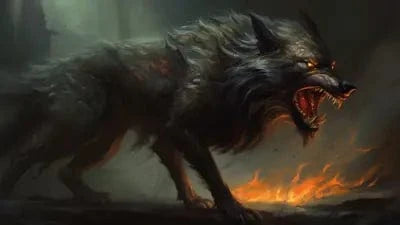
- Fenrir, a giant wolf who, during his imprisonment, tore off Tyr's arm as revenge. He will kill Odin during Ragnarok.
- Hel, goddess of the underworld. She rules over one of the nine worlds, Helheim, which corresponds to hell in Christian religion (in fact, this is where the English word "hell" meaning "inferno" comes from). She is the least dangerous of these three siblings, if we forget that she guards the world where unworthy warriors end their lives.
- Jormungand, a giant serpent who was thrown into the river surrounding Midgard at birth because he was so dangerous. During Ragnarok, he will fight Thor and kill him.
This sibling group was from birth a danger to the gods, indeed, the prophecy foretold that the three brothers would have a devastating impact on the Aesir family. This prophecy proved true: Among others, it is these three brothers, led by Loki who will ravage the world.
Loki also has another son, who is called Nari or Narfi depending on the myths and whom he had with his true wife, Sigyn. He is much less destructive than his brothers-in-law, although his name means "corpse" in Old Norse.
His last son, of whom he is the mother (yes, yes), is Sleipnir, Odin's horse. Loki gave birth to him after transforming into a mare and courting the stallion Svadilfari.

39,99€
50,00€

LOKI, AN ATYPICAL CHARACTER
In the tales, Loki is portrayed as a coward, narcissist, who only cares about his personal pleasure or self-preservation. It is no coincidence that he is considered the god of mischief, illusions, and discord. He alternates between malevolence and altruism, but always in his own interest.
THE KIDNAPPING OF IDUN
One of the most famous tales about him is precisely that of the kidnapping of Idun. Idun is a very important goddess in Norse mythology; she is the guardian of the mysterious fruits that allow the gods to maintain their eternal youth. Returning to Loki, because of his recklessness, he found himself facing an angry giant, Thiazi, who threatened to kill him. Thiazi then proposed to Loki to deliver Idun to him in exchange for sparing his life. Given his character trait, Loki accepted the deal, delivered Idun, and found himself threatened with death by the Aesir gods for sacrificing one of them (logical). To save himself, he decided to rescue Idun by transforming into a Falcon. Thiazi, furious, pursued him by transforming into an eagle. At the moment when Thiazi almost caught Loki and Idun, the Aesir gods lit a fire around Asgard, condemning Thiazi to burn to death. Loki brought Idun safe and sound back to the hall of the gods.
As mentioned earlier, Loki's glorious act (rescuing a god after all) only appears to rectify a calamity for which HE is responsible. This tale is the best known, but the same pattern can be observed in the story of the creation of Thor's hammer or even the construction of Asgard.
The continuation of this myth is quite original. When Thiazi dies, burned by the flames of Asgard, his daughter, Skadi, came to Asgard to demand compensation for this murder. Her only condition was that the Aesir gods make her laugh (this too is original). It was Loki whom the Aesir gods entrusted with this task. To do so, he tied a rope to the beard of a goat and the other end to his testicles. Loki and the goat could not stop screaming, Skadi burst out laughing, and the murder was forgiven.
Once again, Loki's achievements are not worthy of a valiant Viking fighting to prove his worth; he proves his by being stupid and extravagant. Throughout his life, this is what he did, alternating between services rendered to giants and gods, depending on what was most advantageous for him. Once again, during Ragnarok (the devastating battle between gods and giants), he will join the giants' side and even become captain of their ship.

THE DEATH OF BALDUR
Loki is also known for his vicious role in The death of the god Baldur. After the prophecy of the death of the beloved god Baldur, Baldur's mother, Frigg, obtains a promise from every living being not to harm her son. All oaths are obtained except one, that of Gui, whom the gods think too small and too safe to harm Baldur. Loki, discovering this loophole, decides to carve Gui's spear and place it in the hands of the god Hod (who agreed because he was blind) and orders him, using a spell, to throw it at Baldur. Hod, unaware of the weapon's origin, obeys, and Baldur is impaled and dies. The god Hermod rides Sleipnir to the underworld and begs Hel to release Baldur, emphasizing how much he is loved by all living beings. Hel replies that if that is so, it should not be difficult to compel all beings of the world to weep for Baldur, and if that happened, the dead god would be freed from the grave. Indeed, every living being weeps for Baldur's return, with one exception: a giantess with a heart of ice named Tokk. A legend suggests a hypothesis that it was Loki, who had taken the appearance of Tokk.


THE BATTLE OF RAGNAROK
For the various crimes he committed, the Aesir gods decided to bind him to three large rocks with a bond made from the entrails of his son, Narfi. Above him, a venomous serpent dripped its poison on him. His wife, Sigyn, very faithful and in love with him, stayed by his side throughout his imprisonment, holding a bowl to catch all the poison that fell on him, sparing him from excruciating pain. Myths say that when the bowl was full and his wife had to empty it, the few drops that touched his forehead caused him so much pain that his cries caused earthquakes each time.
When the two sons Fenrir, Skoll, and Hati reached their goals (which were to chase respectively the moon and the sun), day and night disappeared and Ragnarok began. It was at this moment that all the bonds broke, releasing among others, Loki and his two sons Fenrir and Jormungand. To take revenge, Loki took command of the giants' army and a disastrous battle began. He sent Fenrir to kill Odin and Jormungand to kill Thor.
I leave you with the Historia video about Loki:
Thank you for reading, it is a pleasure to write for Odin's Hall, the reference brand in accessories inspired by Norse mythology.
To go further, you can continue reading our blogs on Norse deities by starting with the one on the Valkyries, for example.
SKOOOLL! Glory to Loki!